

Information


Services
Efficient water treatment
Grünbeck AG's mission is to ensure that people all over the world have access to hygienically safe water. With know-how, products and communication, Grünbeck, as a water treatment specialist, does everything in its power to implement this right and maintain it in the long term. With the core competence "We understand water", Grünbeck wants to educate the public and water professionals and create WATER KNOWLEDGE®. After all, this is the basis for people's conscious use of water as a vital resource. An important platform for this is the renowned "Grünbeck Forum" training center at the company headquarters in Höchstädt. Water specialists explain industry news and innovative water treatment solutions for the HVAC sector, the food industry and for energy generation. These include products for drinking water treatment as well as systems for water treatment for heating and cooling systems or swimming pools and systems for ultra-pure water treatment for hydrogen production. Grünbeck also offers the highest level of expertise in the planning, design, manufacture and maintenance of these technical water treatment systems.
Grünbeck products stand for quality of life and value retention. Grünbeck develops the sustainable solutions required by customers to conserve resources and reduce consumption in compliance with all legal requirements. Grünbeck's innovative strength is underlined by a large number of trademarks (brands) and numerous patents/utility models. Certification according to DIN EN ISO 9001 as well as numerous country-specific quality certificates underpin the best product quality.
Industries: Building services, swimming pool technology, hydrogen industry, hygiene and healthcare, medical products, food and beverage industry, energy centers, water supply, ultrapure water treatment systems for hydrogen production, drinking water dispensers
Products
Softening systems softliQ
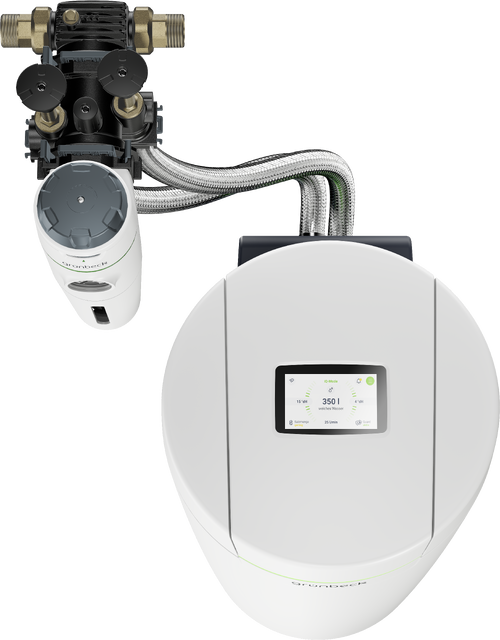
Softening water - simple and effective
More and more private households are appreciating the benefits of softened water. This makes calcified pipes, fittings, household appliances etc. a thing of the past. Grünbeck's softliQ softening systems make the decision to buy one easier. Never before have they been so easy to install and operate and, with the help of artificial intelligence, so efficient.
A lot of development work has gone into the latest generation of softliQ water softeners. After numerous successful tests, they now offer many different benefits.
Particularly helpful for the installer: in combination with the equally new cliQlock module system, the softliQ softeners can be installed without tools and in a matter of seconds. The form-fit design replaces conventional screw connections and therefore time-consuming pipework. Click and seal - installation is that simple. The cliQlock components can be adapted to the respective flow direction of the pipe in just a few seconds by simply twisting them.
The unique cliQlock system offers a high degree of flexibility for both the installer and the end customer. For example, if the latter only wants to use a pureliQ filter in advance, but later decides to install an additional softening system, this will no longer be a problem. This is because the softliQ can simply be retrofitted to the existing 100 mm pipe - again in a matter of seconds and without any time-consuming installation work.
Partial flow filter varioliQ
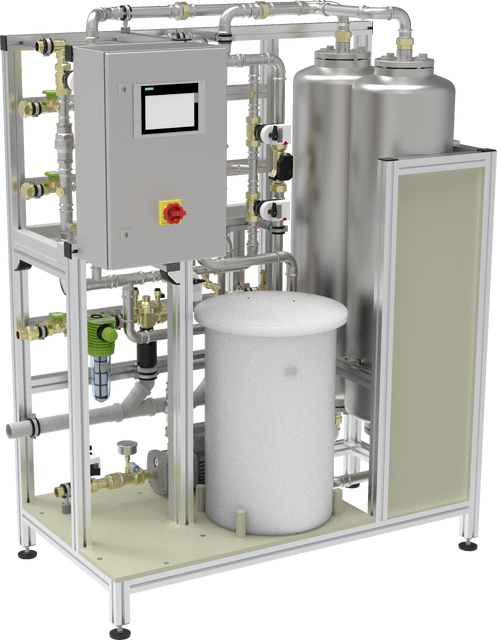
Clean water in closed circuits
With the varioliQ:LB series, Grünbeck has developed new partial flow filters that nowcomplement the innovative water treatment specialist's portfolio. They can be integrated into both new and existing closed heating and cooling circuits. They reliably guarantee high water quality at all times with minimal personnel costs.
Closed water circuits must always function perfectly. It doesn't matter whether it's heating systems in local and district heating, biogas plants, combined heat and power plants and large buildings or cooling systems in data centers, industrial plants and much more. Limescale, rust and other dirt particles must not become a problem here. To prevent this safely and permanently, it is important to maintain the water quality in the circuit at the high level of the applicable guidelines (VDI 2035, AGFW 510, VdTÜV 1466, VDI/BTGA 6044).
This is reliably achieved with the new varioliQ:LB partial flow filters from Grünbeck. They remove all contaminants, limescale and rust from the circulating water, which works fully automatically via the integrated control electronics.
The cleaning process itself is as simple as it is ingenious. The circulation water flows through the various layers of the filtration module, which cleans it. During the subsequent backwash, the individual filter layers are rinsed and simultaneously loosened again, while the retained particles flow into the sewer. The softening module then fulfills its task: it removes calcium and magnesium from the filtered circulation water using the ion exchange principle, thereby reliably preventing limescale deposits.
Fully automatic backwashing and regeneration mean that the filter material does not need to be replaced. These processes are carried out with city water. This means that no valuable circulation water is wasted. At the same time, the integrated bypass pump enables simple and hydraulically independent connection to the circuit. In eco mode, the varioliQ:LB also achieves particularly energy-saving operation.
Another advantage of the partial flow filter is that lost water can also be compensated for via the system. This means that the make-up water is always optimally treated. And to protect pipes, fittings, pumps and heat exchangers etc. from corrosion, a dosing system for targeted pH value adjustment can also be integrated.
The new varioliQ:LB partial flow filters are designed for temperatures up to 90 °C and for a pressure of 14 bar and are available in two sizes: as varioliQ:LB3000 with a nominal connection diameter of DN 25 and a nominal flow rate of 3.0m3/h and as varioliQ:LB4500 with a nominal connection diameter of DN 32 and a nominal flow rate of 4.5m3/h. Both are also available as mobile versions with four swivel castors and dead man's handle for maximum safety.
Large-scale softener softliQ:LB
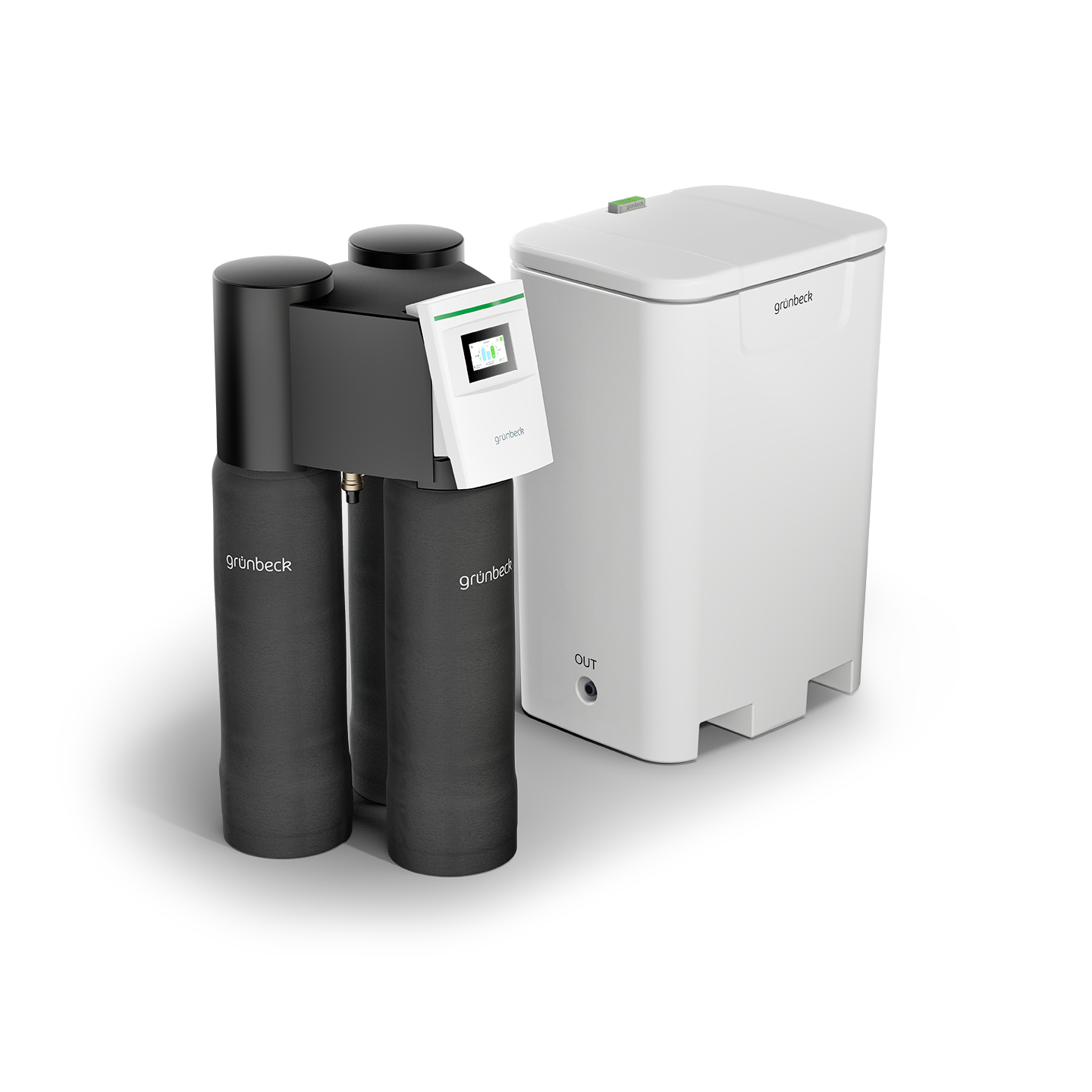
Thanks to innovative development work, Grünbeck's softliQ:B triple softener is ultimately as efficient as two double softeners.
In addition, it has numerous features that ensure reliable operation and ease of use.
Operators of residential complexes, businesses and hotels generally have high demands when it comes to water treatment. High flow rates must always go hand in hand with low pressure loss. The completely newly developed softliQ:LB water softener from Grünbeck was designed precisely for these applications.
At the heart of the system is the unique three-column design. This makes it possible to treat up to 20 cubic meters of water per hour. The sophisticated technology is based on a patented three-way ball valve. With the help of this valuable component, three exchangers can be connected to each other, two of which are permanently flowed through in parallel. This provides the operator with a continuous supply of soft water.
This innovative technical design ensures low pressure losses with a maximum flow rate. This can result in several advantages for the overall installation. For example, it may be possible to use smaller pipes, which reduces the amount of material used and cuts costs. A second softening system to increase capacity and a pressure booster system can also be dispensed with.
Another highlight: the large salt container with clever functions. Every softliQ:LB water softener has a salt container with a filling capacity of 275 kilograms as standard. This extends the refill intervals and reduces operating costs. Grünbeck has also integrated a sensor in the lid of the system to display the amount of salt so that the infrequent refilling is never forgotten. The operator is automatically informed as soon as the salt runs low - via the myProduct app or an optional bus connection for building management systems.
The new softliQ salt container also allows maintenance staff to rinse out salt sludge quickly and easily without having to empty the regenerating salt first. Residues are directed into the drain via the specially designed salt container base using intelligently fitted rinsing connections. Quickly and efficiently, saving valuable time. A robust pallet truck holder also makes it easier for a single person to transport a full container.
The leakage protection is just as intelligent. It uses an integrated water sensor to monitor the installation location of the softliQ:LB. If water collects on the floor - for whatever reason - a push notification is automatically sent to the maintenance technician so that they can react immediately and prevent damage.
Thanks to the intuitive operating unit with touchscreen, every operator inspection is just as easy to carry out as the installation of the Grünbeck water softener is for the specialist installer. Even during initial commissioning, the user is guided safely through the commissioning program so that errors are virtually eliminated. Easier and faster than ever before.
As an option, the softliQ:LB large-scale softening system can even be ordered pre-assembled on a transport-friendly platform and already filled with resin. This significantly reduces the installation work on site once again, which is very much to the benefit of the specialist installer and operator. Another available accessory is exchanger insulation, which ensures that no condensation forms on the exchanger cylinders in the event of high temperature differences.
OsmoliQ:KA reverse osmosis system
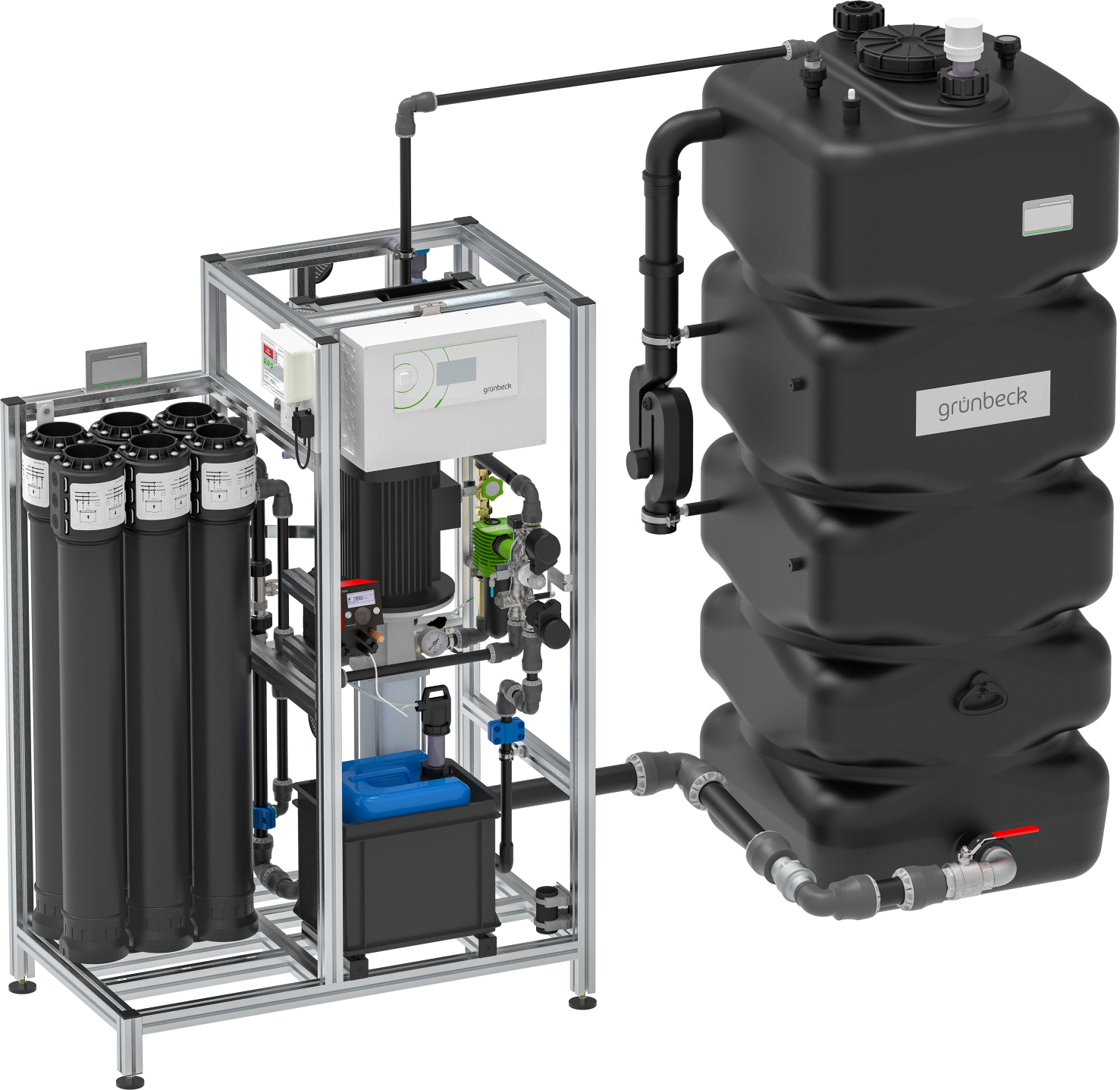
With Grünbeck's osmoliQ:KA, the yield of existing reverse osmosis systems can be increased to up to 90 % - for more sustainability, lower operating costs and maximum resource utilization.
Maximum yield through intelligent retrofitting
The osmoliQ:KA reverse osmosis concentrate stage is the ideal addition to existing reverse osmosis systems. It utilizes the previously unused potential of the concentrate and treats it again - for a significant increase in the overall system yield of up to 90 %. It therefore makes a valuable contribution to conserving resources and improving the environmental balance in accordance with DIN ISO 14001.
Efficient, flexible, economical
The osmoliQ:KA is designed as a stand-alone unit and can be operated independently of the main stage. Thanks to its modular frame, it is quick and easy to install - whether in new or existing systems. The low-noise, frequency-controlled high-pressure pump ensures energy-efficient operation. The system is available in various output levels from 400 to 3,000 l/h and can be precisely matched to the requirements of the respective main stage.
Technology that impresses
The system works according to the proven principle of reverse osmosis. The concentrate from the main stage is collected in an unpressurized concentrate collection tank and then serves as feed water for the concentrate stage. It is fed to the membranes via a stainless steel high-pressure pump, where it is again separated into permeate and concentrate. The permeate obtained is fed back into the main stage and runs through the treatment process again - a closed cycle with maximum efficiency.
Intelligent control and safety
The system is controlled via a modern 4.3" touch panel, which clearly displays all operating statuses. An integrated fill level monitor protects the high-pressure pump from running dry. Conductivity measurement in the permeate flow enables continuous quality control. All operating data is logged on an SD card. The system can be easily integrated into existing control systems via Modbus RTU or optional interfaces such as Profibus DP or BACnet IP.
Protection of the membranes through antiscalant dosing
An integrated antiscalant dosing system ensures the quantity-proportional addition of hardness stabilizers. This reliably prevents the crystallization of poorly soluble salts on the membranes - known as scaling. This increases the service life of the membranes and reduces maintenance costs.
Robust design for industrial applications
The osmoliQ:KA is designed for durability and easy maintenance. The anodized aluminium frame with levelling feet ensures stability. The piping is made of chemical-resistant PE with PP fittings. The high-pressure centrifugal pump made of stainless steel 1.4401 is equipped with a frequency converter and enables precise control of the yield and permeate output.
Application example: osmoliQ:KA1600
In combination with a main stage such as the osmoliQ:LB12000, the osmoliQ:KA1600 can significantly reduce the concentrate volume. The result: less waste water, lower disposal costs and a significantly improved water balance.
Sustainability meets economy
The osmoliQ:KA not only reduces the volume of wastewater, but also lowers operating costs through more efficient use of the water used. It is available in various performance levels and can be individually adapted to the requirements of the existing system. In many cases, the investment pays for itself within a short time - especially when water prices are high or environmental regulations are strict.
Technical highlights at a glance
- Permeate output: 400 to 3,000 l/h (at 15 °C)
- Typical yield: 50 % per stage, up to 90 % in total
- Salt retention: 95 - 99 %
- Nominal pressure: PN 16
- Feed water temperature: 10 - 30 °C
- Ambient temperature: 5 - 35 °C
- Protection class: IP 54
- Mains connection: 230/400 V, 50 - 60 Hz, 3/N/PE
- Communication: Modbus RTU, optional Profibus DP, BACnet IP
Projects
Perfect circulating water for local heating network
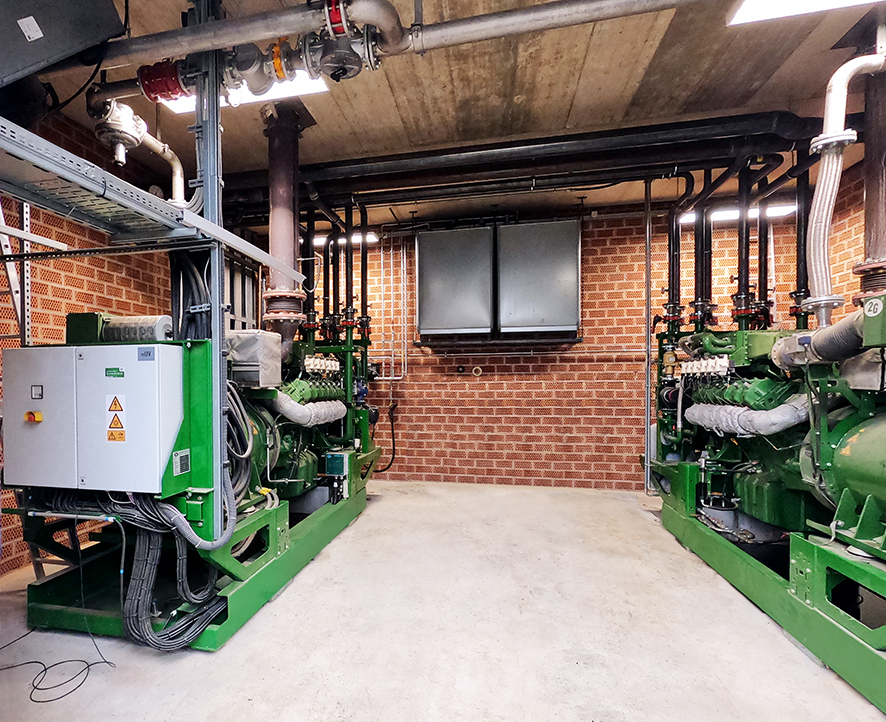
Permanent solution - with expertise and partial flow filters from Grünbeck
Regardless of the size of a heating network, the quality of the water in the buffer tank and in the circuit is a key prerequisite for long-term, trouble-free and sustainable operation. The biogas plant in Finningen was built in 2004, followed by the founding of GSW Finningen KG in 2013. As part of the expansion of its biogas-powered local heating plant in 2024, the company sought expert support. After extensive consultation, Michael Engelmayer, owner of GSW Finningen, opted for an initial filling using a rental reverse osmosis system and the installation of a varioliQ partial flow filter from Grünbeck.
Thinking outside the box is a characteristic that has characterized the Engelmayer farming family for decades. Reiner Engelmayer began operating his first small biogas plant to generate electricity back in the late 1990s. in 2004, he then put a second, much larger plant into operation on a greenfield site near his home town of Finningen. Originally equipped with a combined heat and power unit (CHP), the plant has been continuously expanded over the years and now comprises four CHP units with a maximum total output of 2,000 kW.
His son Michael (now 36) was still in training in the mid-2000s. Even then, however, it was clear to him that this business model would be his future. So in 2014 - now qualified as a master farmer - he supplemented the electricity generation with a local heating network. "I just thought it was a shame about the heat that combined heat and power plants automatically produce when generating electricity. Until then, it had been blown into the air unused," says Michael Engelmayer. "However, as the investment in a heating network also has to be economically viable, we calculated how many households we needed to connect in Finningen: at least 70, and 80 in the first expansion stage."
In the past, a CHP always had to run, today we have a large buffer storage tank
Each connected household has a 1,000-liter buffer storage tank. In order to always have enough heat available for heating and hot water, GSW Finningen always had to have at least one CHP unit running. Even when the electricity traded on the exchange was not generating any revenue. "From an economic point of view, of course, that was nonsense," says Engelmayer.
The master farmer found the solution to this problem in a central buffer storage facility of a completely different dimension, which was installed next to his biogas plant in 2024. It now constantly holds 2,000m3 of hot water at a temperature of 78 to 85 degrees Celsius. This corresponds to approximately 45 times the amount of water that will be in his local heating circuit when - in addition to the 110 households connected today - the additional 25 houses planned for the final expansion are also put into operation.
Michael Engelmayer is very satisfied with the new solution: "This means we always have enough hot water available and are only able to run our power plants when electricity is needed and paid for in the grid, such as in the early hours of the morning. But then at full capacity of 2,000 kW." The Engelmayers grow some of the energy-rich raw materials required to operate the biogas plant - such as maize, beet and grass - on their own fields, while the rest is bought in regionally. The permanently produced gas is stored in huge tanks and fed to the combined heat and power plants to generate electricity as soon as it is needed.
Decisive challenge: clean circulating water with a high pH value
The path to today's optimally functioning local heating system with a huge buffer storage tank was not easy. Thanks to competent partners, however, everything went smoothly, as Michael Engelmayer confirms: "The tip from a professional colleague who told me that he had had the best experience with Grünbeck AG when it came to water treatment was crucial." As Grünbeck's main plant in Höchstädt is only a few kilometers away, it made sense for him to ask for advice there.
The head of GSW Finningen immediately found the right contact person in Grünbeck sales consultant Andreas Voggenreiter. Even before the first water analysis, he explained what is important when treating recirculating water: "The water quality is the basis for smooth operation. This means that it should meet the requirements of VdTÜV 1466, be low in salt, have a total hardness of < 0.1 °dH and at the same time have a high pH value, which should be around 9 to 9.5." Background to the latter factor: If the pH values are significantly lower (pH < 8), corrosion in the buffer tank - which is usually made of normal structural steel for cost reasons - and therefore also in the pipes is pre-programmed.
Desalination in the partial flow would therefore be the wrong approach. Although this physical process produces water of a very high quality, it automatically becomes acidic with a pH value of 6 to 7. Circulating water with a buffer tank, as required for local and district heating, would therefore have to be permanently supplemented with lye to prevent corrosion.
Initial filling with rental reverse osmosis system and partial flow filter with dosing unit permanently installed
After carefully analyzing the raw water on site, Andreas Voggenreiter was able to offer a perfect solution: "We lend our customers a reverse osmosis system for the initial filling of the buffer tank. A permanently installed partial flow filter from our Grünbeck varioliQ series then filters out all suspended solids, limescale and corrosion components contained in the water as well as those that arise. Ideally - and implemented at GSW Finningen - a dosing unit is also integrated. This treats the water with caustic soda so that the ideal pH value of around 9.5 is guaranteed."
Michael Engelmayer opted for precisely this solution when commissioning his 2,000 m3 buffer storage tank and is delighted: "Everything worked exactly as predicted." In other words, the existing heating network was initially kept separate and not connected to the new buffer tank. A supplier built this on site by welding it together from individual steel plates. GSW Finningen KG then filled the tank with low-salt water using the rental reverse osmosis system.
The entire construction process for the buffer tank took more than three months. During this time, a lot of flash rust formed on the structural steel, which dissolved in the water when the tank was filled. "At first, an unbelievable amount of rust came out, and at this point at the latest, I was really glad that we opted for the Grünbeck solution with the varioliQ partial flow filter," confirms Engelmayer.
This is because the partial-flow filters from other manufacturers are often equipped with filter bags that have to be replaced manually. The GSW Finningen boss knows from other heating network operators how this works: "In the beginning, the relatively expensive bags have to be replaced almost daily until the water is largely clean. It's unpleasant work because the filter bags are hot and often smell extremely unpleasant."
The varioliQ partial flow filter from Grünbeck cleans and regenerates fully automatically
The varioliQ from Grünbeck does everything fully automatically. Within six weeks, the entire circulation water in the partial flow was cleaned without any manual work. The Grünbeck technology uses an ingenious cleaning principle: The circulation water flows through the various layers of the filtration module, which cleans it. During the subsequent backwashing process, the individual filter layers are rinsed and loosened up again at the same time, while the retained particles flow into the sewer.
The softening module then fulfills its task: it removes calcium and magnesium ions from the filtered circulation water using the ion exchange principle, thereby reliably preventing limescale deposits. Fully automatic backwashing and regeneration means that the filter material and exchanger resin do not need to be replaced. As these processes are carried out with fresh water, no valuable circulation water is wasted.
The additional dosing unit installed at GSW Finningen ensures targeted pH value adjustment by adding ten percent caustic soda. "After filling the boiler, this was of course particularly important," explains Grünbeck consultant Voggenreiter. "We first had to get from 6.8 to a good 9. But even after that, the pH value has to be checked regularly and adjusted if necessary."
Engelmayer checks the pH value himself at intervals of around four weeks. He has a suitable measuring device from Grünbeck for this purpose, which he simply holds in the water. Every six to twelve months, a Grünbeck service employee analyzes the overall quality of the circulation water. According to Andreas Voggenreiter, there are usually no problems: "But if we do find any irregularities, our specialists solve them quickly and easily."
Conclusion: GSW Finningen KG is characterized by progressive thinking and action. In particular, the company's local heating network, which has been expanded with a 2,000 m³ buffer storage tank, shows how important perfectly treated circulation water is for efficiency and longevity. Grünbeck's expertise and technical solution, which consists of a rental reverse osmosis system and the varioliQ 3000 partial flow filter with integrated dosing unit, is crucial for this. This not only reliably removes dirt and limescale, but also keeps the pH value stable at around 9.5. Corrosion protection, minimal maintenance and maximum operational reliability are thus guaranteed - a prime example of sustainable heat supply.
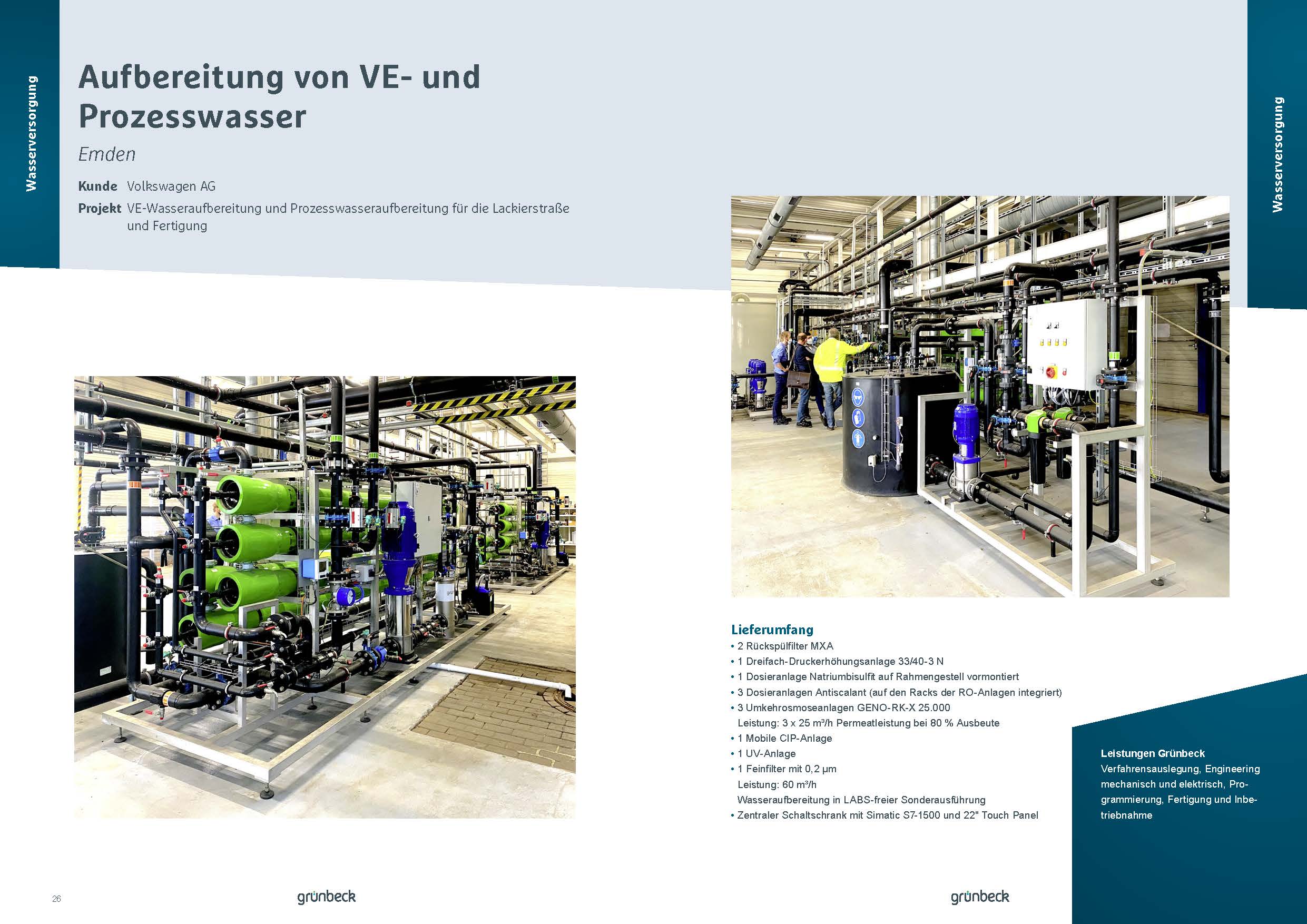
Reference - Treatment of demineralized and process water
Markets
Contact
Grünbeck AG
Grünbeck AG
Industriestraße 4
79194 Gundelfingen (Breisgau)
Germany
More locations
Headquarter Höchstädt a. d. Donau
Grünbeck AG is responsible for the content of this company profile as well as the compliance with the copyrights of the image material.